

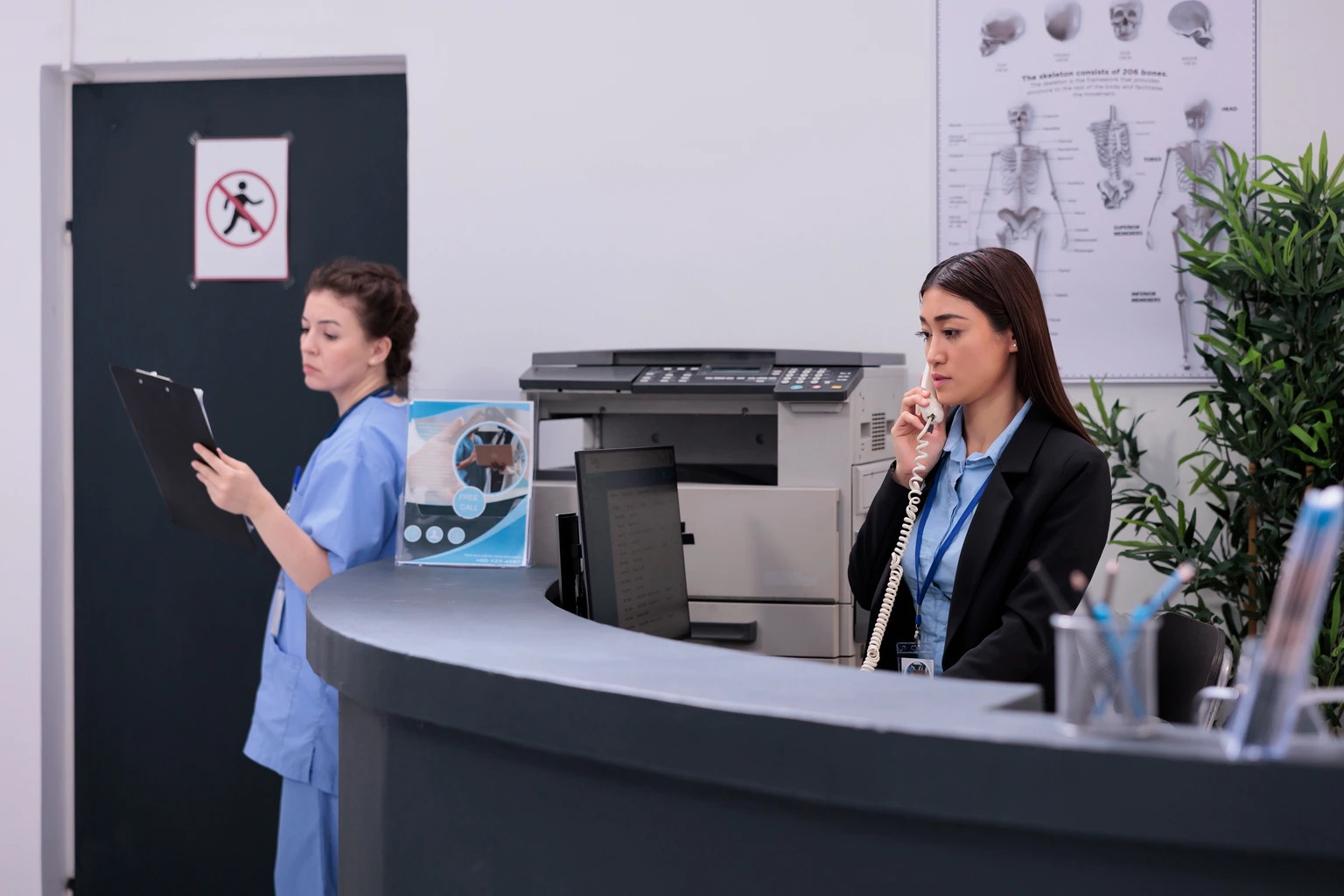
Anyone who has spent a shift on a medical reception desk knows the pattern: the phone rings while someone’s checking in at the counter, another call is already on hold, and a patient at the window is waiting to book a follow-up. Reception teams in healthcare aren’t understaffed because clinics are badly run – they’re stretched because call volume in medical practices is genuinely relentless, and there’s rarely a quiet moment to catch up.
This is the gap an AI receptionist is built to close. Pear Australia’s ARIA, Reimagined is designed specifically around this problem, picking up overflow calls, answering common patient questions and routing enquiries so reception staff aren’t trying to be in three places on the phone at once.
What Is an AI Receptionist, Exactly?
An AI receptionist answers incoming calls using conversational voice technology, understands what the caller needs, and either resolves the enquiry directly or routes it to the right person. For a medical practice, that might mean confirming clinic hours, taking a message, or directing an urgent call straight through to a nurse rather than leaving it in a queue behind routine bookings.
It isn’t meant to replace the reception team. It’s meant to absorb the repetitive, high-volume part of the job – the questions asked twenty times a day – so the people at the desk can focus on patients who are actually standing in front of them.
Where Reception Teams Struggle Most
A few patterns show up again and again in medical practices, regardless of size:
- Call volume spikes at predictable times – Monday mornings, the start of flu season, right after a public holiday – that no amount of staffing feels quite prepared for.
- After-hours calls go unanswered, or get routed to a generic answering service that doesn’t understand the practice’s booking system or triage priorities.
- Simple questions consume disproportionate time – hours, parking, whether a referral is needed – that could be handled without a staff member picking up at all.
- Urgent calls sometimes wait behind routine ones, simply because a human receptionist can only handle one caller at a time.
None of these is a staffing failure. They’re the predictable result of call volume that doesn’t match available hands on any given day.
How a Healthcare AI Receptionist Actually Helps
A well-built healthcare AI receptionist doesn’t try to handle everything – it takes on the calls that don’t need a judgement call, and gets out of the way for the ones that do. In practice, that usually looks like:
- Answering routine questions about hours, location and services instantly, without a queue
- Taking messages and basic booking requests outside normal reception hours
- Using intelligent call routing to send urgent calls straight to clinical staff rather than holding them in a general queue
- Reducing the number of calls that go to voicemail during peak periods, which in a medical setting often means fewer missed appointment changes or cancellations
The value isn’t really about replacing conversation – it’s about making sure the right calls reach a person quickly, while the repetitive ones get handled without adding to anyone’s workload.
AI Voice Assistant vs a Traditional Answering Service
It’s worth being clear about the difference, since the two get mixed up. A traditional after-hours answering service is usually a person reading from a script, often without visibility into the practice’s actual booking system or triage protocols. An AI voice assistant built specifically for healthcare can be configured around the practice’s own information – its hours, its services, its escalation rules – and respond consistently, at any hour, without the variability that comes from different staff answering the phone differently.
That consistency matters more in healthcare than in most other industries, where a wrong answer about hours is a minor inconvenience but a mishandled urgent call is not.
Privacy and Compliance Considerations
Any technology handling patient calls needs to take privacy seriously, and this is worth raising directly rather than glossing over. Practices considering a virtual receptionist for healthcare should confirm how patient information is stored, who can access it, and how the system aligns with obligations under Australian privacy law. The Office of the Australian Information Commissioner sets out the Australian Privacy Principles that govern how organisations, including medical practices, must collect and handle personal information – a useful reference point when evaluating any new communication technology that touches patient data.
Integrating an AI Receptionist With Existing Systems
An AI receptionist works best when it isn’t a standalone add-on bolted onto an otherwise unrelated phone setup. Practices already running a custom VoIP and cloud communication system for healthcare are generally better positioned to integrate an AI receptionist cleanly, since call routing, queue management and analytics can work together rather than as separate, disconnected tools competing for the same phone line.
This kind of integration is part of why healthcare communication solutions are increasingly built around a single connected system rather than a phone line, a separate answering service, and a booking platform that don’t talk to each other.
Who Actually Benefits From This
An AI receptionist tends to make the biggest difference for:
- Medical centres and multi-doctor clinics fielding high call volumes across multiple practitioners’ schedules
- Practices with limited after-hours staffing, where calls would otherwise go unanswered outside business hours
- Specialist clinics where booking and referral questions follow a repeatable pattern that doesn’t need a judgement call each time
- Growing practices adding patients faster than reception staffing can reasonably scale
Pear Australia works with medical centres and clinics across the country to build communication systems suited to healthcare environments, where privacy, call volume and patient experience all need to be balanced at once.
What a Modern Healthcare Phone System Looks Like Together
An AI receptionist is one part of a larger picture. A well-set-up healthcare phone system typically pairs intelligent call handling with a Cloud Hosted PBX that manages routing, extensions and analytics behind the scenes. Together, they give a practice a clearer picture of call volume, response times and where patients are actually getting stuck, rather than relying on a single receptionist’s memory of a particularly busy Tuesday.
Measuring Whether It’s Actually Working
It’s worth deciding upfront how a practice will judge whether an AI receptionist is pulling its weight, rather than assuming it’s working simply because the phones feel quieter. A few practical measures tend to matter more than gut feel:
- Missed call rate before and after – a meaningful drop suggests fewer patients are hanging up in frustration or giving up on booking altogether.
- Average time to answer, especially during known peak periods like Monday mornings.
- How many after-hours calls actually get resolved versus simply logged for a callback the next day.
- Reception staff feedback – the people fielding the calls that remain usually have a clear sense of whether the workload genuinely feels lighter.
None of this needs to be complicated tracking. Most cloud phone systems already generate call analytics that make these numbers visible without any extra setup, which is often the simplest way to confirm the change is actually delivering what it promised rather than just sounding good in theory.
Conclusion
Healthcare communication doesn’t need to mean choosing between overworked reception staff and an impersonal answering machine. An AI receptionist, properly integrated with the practice’s existing phone system, absorbs the repetitive call volume that eats up a reception team’s day, while making sure urgent calls still reach a person quickly. For practices weighing up whether an AI receptionist for healthcare is worth the change, the honest answer usually comes down to how much of the day is currently spent on calls that didn’t need a human decision at all.
If your practice is fielding more calls than your reception team can comfortably manage, contact Pear Australia to talk through how ARIA and a connected healthcare phone system could support your team. Call 1300 007 327 or visit peartelco.com.au.
Frequently Asked Questions
1. Will an AI receptionist replace my medical reception staff?
No. It’s designed to absorb repetitive, high-volume calls and after-hours enquiries, freeing reception staff to focus on patients in front of them and calls that genuinely need a person’s judgement.
2. How does an AI receptionist handle urgent patient calls?
Through intelligent call routing, urgent calls are typically identified and sent directly to clinical staff rather than being held in a general queue behind routine bookings and enquiries.
3. Is patient data safe with an AI voice assistant?
It should be, provided the system is built with privacy obligations in mind. Practices should confirm how patient information is stored and accessed in line with the Australian Privacy Principles before adopting any new communication technology.
4. Can an AI receptionist work with our existing phone system?
Generally, yes, particularly if your practice already runs a cloud-based VoIP or hosted PBX system, since call routing and analytics can be connected rather than run as separate, disconnected tools.
5. What size practice actually benefits from an AI receptionist?
Both small and large practices can benefit, though the difference tends to be most noticeable in multi-doctor clinics, practices with limited after-hours staffing, and growing practices where call volume is increasing faster than reception headcount.